Infrastructure
High Performance Computing (HPC): Cebule HPC
With the Python-SDK you can easily send tasks to the Cebule Engine to perform quantum chemistry calculations such as for Implicit Solvation (COSMO), Born-Oppenheimer Molecular Dynamics (BOMD), Path Integral Molecular Dynamics (PIMD) and other ab-initio models. Cebule also lets you interface with the MQS Graph Neural Network library and a generative adversarial network (GAN).
The Cebule Engine task manager accessible through the dashboard gives a good overview of all your tasks and if they have completed or if they are still running on the MQS High Performance Compute (HPC) Infrastructure. THe infrastructure is currently running on ARM processors and is easily scalable to 100s and 1000s of CPUs based on how the usage grows.
We try to run our self-hosted infrastructure as energy efficient and sustainable as possible to provide you with a painless experience to run quantum chemistry calculations without the need of thinking of how to compile a specific quantum chemistry package or how to even set up a high performance server.
AWS CloudFormation Template (CFT)
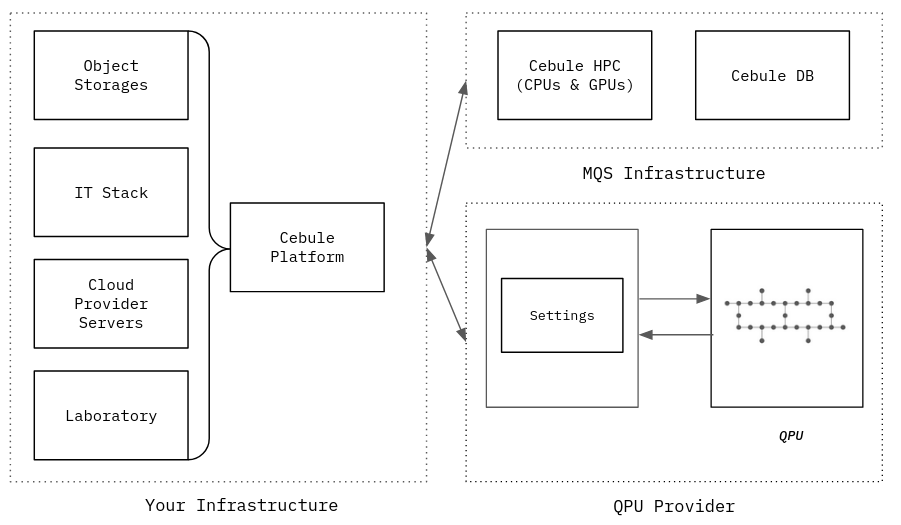
You can retrieve the whole Cebule platform on your own infrastructure, either on-premise or through cloud marketplace providers such as AWS and Azure.
The following diagram depicts the complete infrastructure setup you will get:
-
Cebule Dashboard: A convenient user interface (UI) and user experience (UX) for getting a quick overview of molecular data and your calculation pipelines.
-
Cebule Engine and API/SDK: High-throughput screening of molecules made simple with a convenient SDK to tackle quantum chemistry, quantum computing, machine learning and chemical engineering applications.
-
Cebule Database: Deploy the Cebule DB schema for storing your own data and external connect to multi-terrabyte large datasets hosted on MQS infrastructure. In this way you save storage space with read/request public open access data while keeping your own internal data secure.
-
Lab connect capabilities: Combine in-silico simulations with Bayesian design of experiments to set up closed-loop robot arm driven lab workflows.
-
JupyterHub and Kubeflow: Maintain your projects with JupyterHub and Kubeflow for reproducibility and maintainability.
-
Self-deployable multi-agent LLM system: Accelerate your research and engineering tasks with a safe and secure multi-agent LLM framework which you can modify and select yourself which LLM models you want to rely on.
S3 Compatible Object Storages
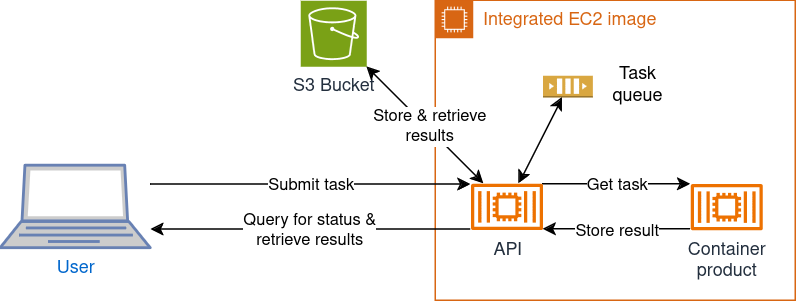
Come with your own object storage and connect it to Cebule to secure your data on your own provider of choice. The MQS platform allows you to connect your S3 compatible object storage of choice. This allows also a more refined authentication setup from an enterprise perspective if you have different team members you want to collaborate with and who have different user priviliges with respect to the different object storage buckets you are working together with.
-
Generate the access key / URL to your object storage bucket via the specific provider platform of your choice.
-
Add the object storage access key / URL in the Cebule Dashboard Stats & Settings page.
-
Test a calculation task via the Cebule SDK or the Cebule Engine Dashboard.
-
View the running tasks in the Cebule Engine Dashboard and access the S3 bucket URL to retrieve the results when the task has been completed.
Git Version Control
The MQS Infrastructure also holds a git system to be able to collaborate on partnership projects or when MQS delivers tailored Python packages and containers to customers.
If you are interested to also have access to a git system under the Cebule Tier, then let us know and we can figure out what you exactly need.
Container Registry
Our self-hosted container registry allows us to deliver compiled container images for different processor architectures (CPUs: Intel, ARM, AMD; GPUs: Nvidia, AMD). With the CloudFormation Template (CFT) all these images can be run on your own infrastructure.
Please contact us if you have a special request with respect to the infrastructure and we will make it work: contact (at) mqs [dot] dk