Quantum Computing
On this page we are going to present you the quantum computing methods we have developed and made available through our SDK:
-
A mapping and measurement method for electronic structure problem formulations 1
-
A tensor networks based methodology to optimize an Hamiltonian for generating an optimized Hamiltonian to be solved on a classical computer (CPU, GPU) while at the same time generating an improved state with a quantum circuit (Ansatz) to be solved on a QPU. 2
-
Active space selection methods
-
Zero-noise extrapolation
-
Quantum circuit generation methods such as our genetic evolution method in our Xenakis package
-
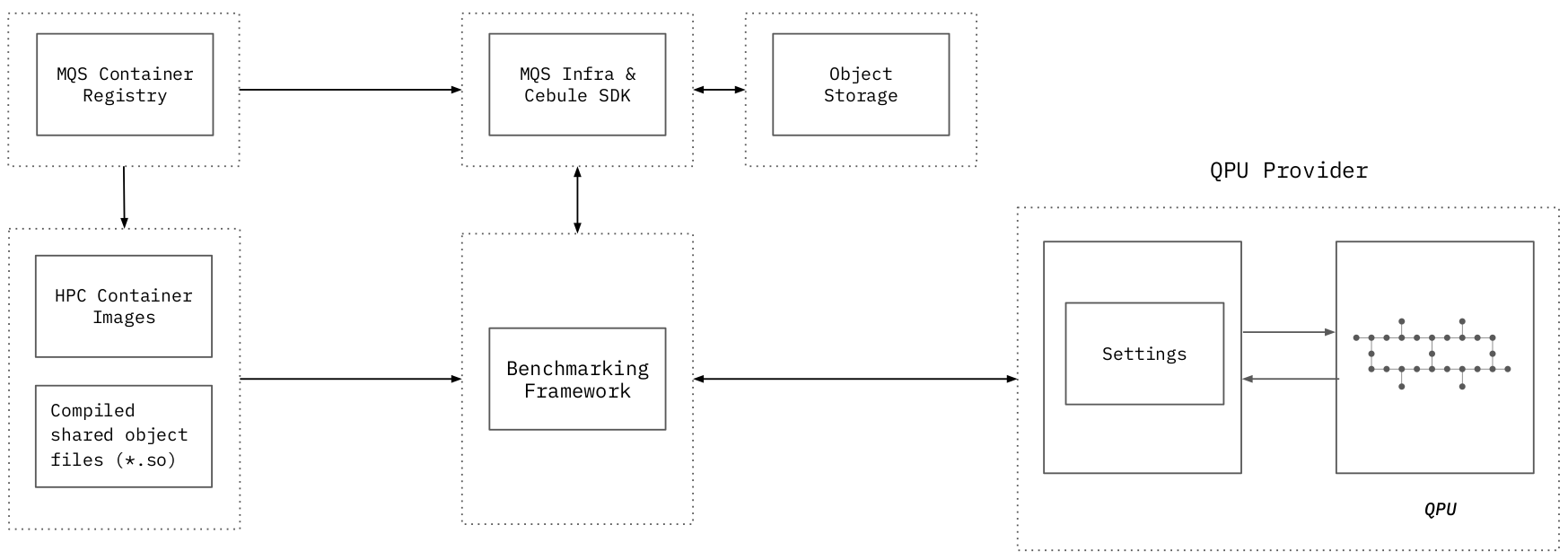
Our open-source benchmarking framework to test different variational quantum algorithms (VQA) such as VQE, QAOA etc. and other methods (QSE, GQE, CP-SAT).
-
Our research articles and research projects
A Cebule SDK task can be run in the following way:
# Import needed packages
from dotenv import load_dotenv
import json
import mqsdk
from mqsdk.core.cebule import TaskType
import os

# Initialize the SDK with user credentials
load_dotenv()
session = mqsdk.Cebule(os.environ['EMAIL'], os.environ['PASSWORD'])

# The input data specific to the individual task types
input_data = '''
{
    "geometry": [
        0.0, 0.0, -0.068,
        0.0, -0.791, 0.544,
        0.0, 0.791, 0.544
    ],
    "symbols": ["O", "H", "H"],
    ...
    ...
}
'''

# Run a task via Cebule SDK on the Cebule HPC
task = session.cebule.create_task("Your title for the specific task run", TaskType.MOL_MAP, input_data)
For more information about the Cebule SDK: https://gitlab.com/mqsdk/python-sdk
Mapping and measurement of electronic structure problems via gate-based quantum circuits
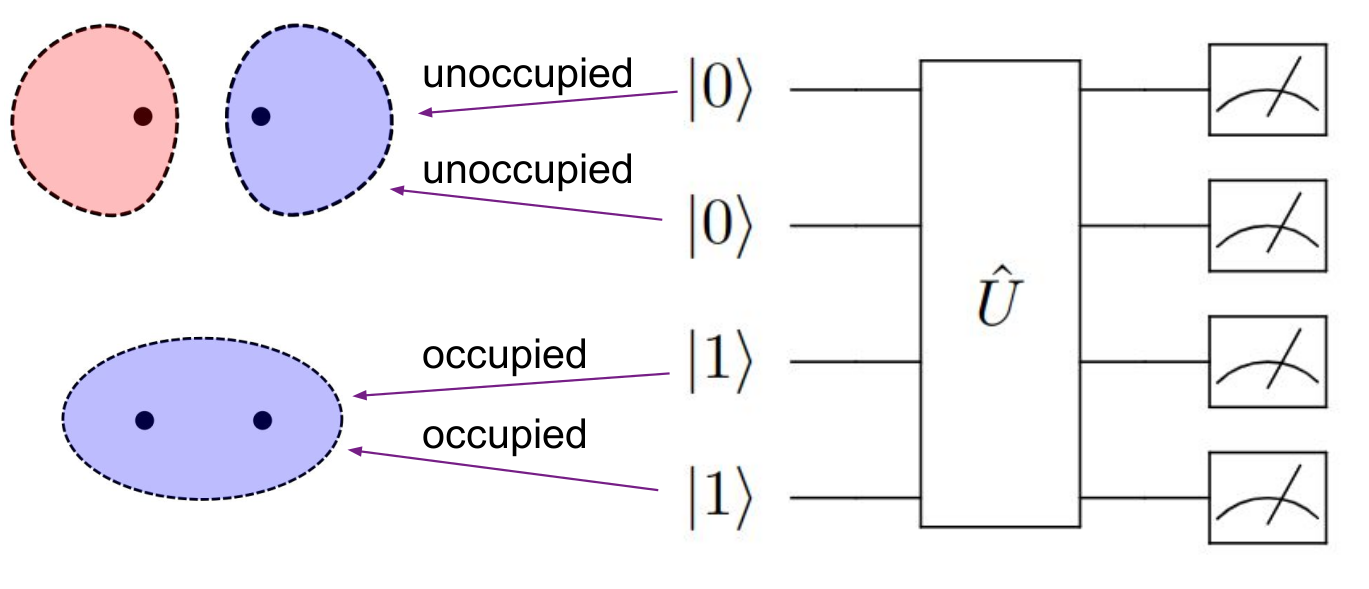
Mapping method
Purpose
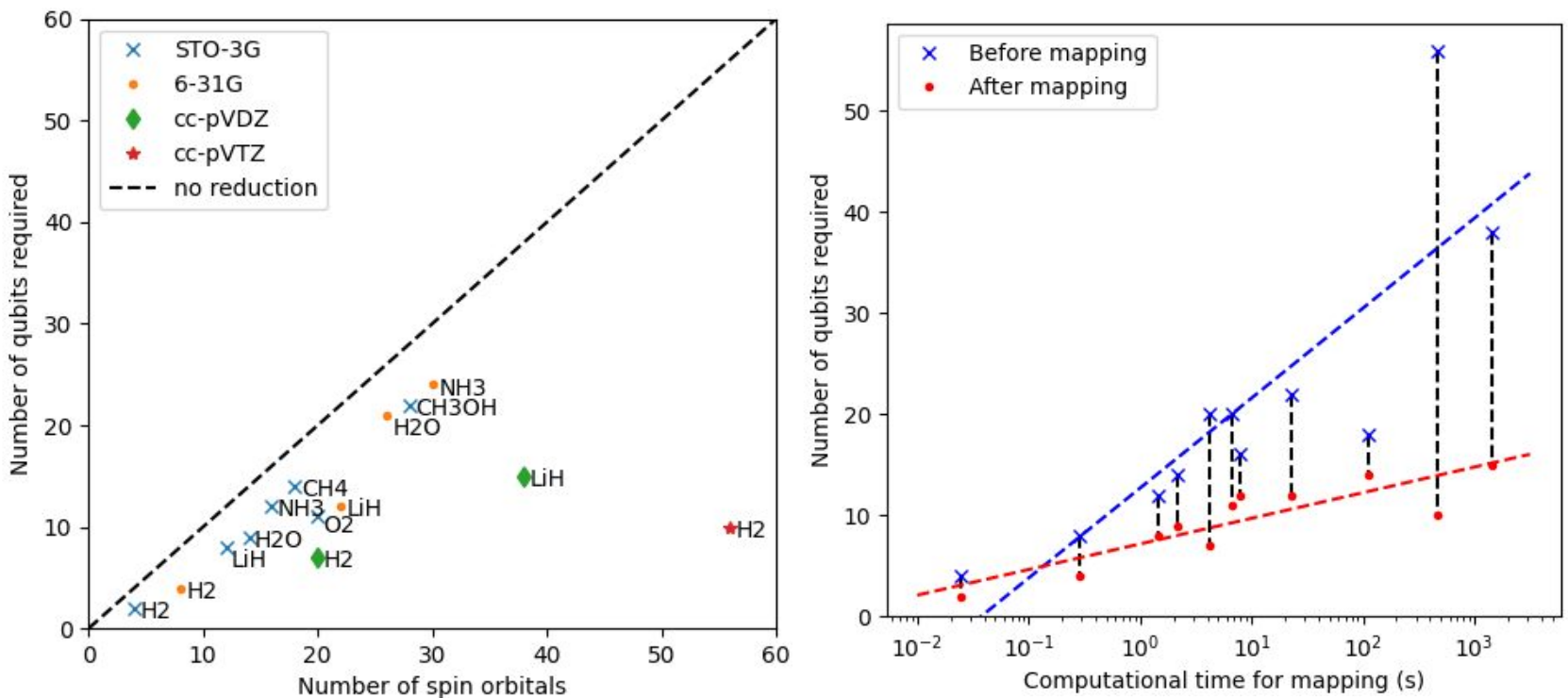
The mapping method creates a custom encoding of molecular electronic states onto quantum hardware that respects problem constraints (such as fixed electron number and spin multiplicity) while using fewer qubits than standard encodings like Jordan-Wigner.
Key Features
- Reduced Qubit Requirements: Constraint-based mapping significantly decreases the number of qubits needed to represent molecular systems
- Efficient Measurements: Novel measurement scheme reduces circuit complexity for Hamiltonian expectation value estimation
- No Approximations: Methods preserve the full physics of the quantum chemistry problem
- Classical Preprocessing: Resource-intensive calculations performed classically, executed only once per problem
Benefits
- Automatic Constraint Enforcement: VQE optimization is confined to physically valid states
- Faster Convergence: Smaller search space leads to more efficient optimization
- Hardware Efficiency: Fewer qubits required, especially beneficial for larger basis sets
- Exact Results: No approximations to the underlying physics
How It Works
-
Define Constraints: Specify physical constraints for your molecular system:
-
Number of electrons (typically matching nuclear charge for neutral molecules)
- Spin multiplicity (singlet, doublet, triplet, etc.)
-
Spatial symmetries (optional)
-
Identify Valid States: The method identifies the subspace of Fock space states that satisfy all constraints. For N spin orbitals and M valid states satisfying constraints, only \(log_2(M)\) qubits are needed instead of N qubits.
- Generate Custom Mapping: A bijective mapping operator D is constructed that maps the valid subspace to computational basis states on the quantum computer.
- Transform Hamiltonian: The molecular Hamiltonian is transformed to operate in the reduced Hilbert space: \(H_H= D H D^{\dagger}\)
TaskType: mol_map
- Inputs
geometry: array 1-d, list Geometry of molecule
symbols: array 1-d, list Element symbol (letters) for each atom in the geometry and in sequence how defined in the geometry. E.g. symbol for hydrogen is "H" for iron thek symbol is "Fe".
basis: string Basis set definition (Default: "sto3g")
multiplicity: value Spin multiplicity enforced by projection of the determinant wavefunction. E.g., a singlet state has value 1 and a triplet state the value 3. The ground state of most molecules is a singlet state (value of 1).
charge: value Total charge of the molecule.
- Output
mapped_hamiltonian: array 2-d, list (float) The mapped Hamiltonian in sparse format. Each element has a list defining the row, column and value of each element in the Hamiltonian matrix.
hf_state: list (int) The Hartree Fock ground state in the new basis.
mapping_matrix: array 2-d, list (float) The mapping matrix \(D\) generated from the molecular Hamiltonian (Hilbert space). The matrix is a mapping from the Hilbert space to the subspace in sparse format. Each element has a list defines the row, column and value of each element in the mapping matrix \(D\).
Measurement method
Purpose
The measurement method efficiently evaluates the expectation value of the mapped Hamiltonian using a novel circuit generation scheme that groups terms by computational basis state pairs rather than Pauli string decomposition.
How it works
Express Hamiltonian in Basis States: The Hamiltonian is written as:
where \(\ket{m}\) and \(\ket{m'}\) are computational basis states.
Partition Terms: Terms are divided into two groups:
Diagonal terms (\(m = m'\)): Measured directly in computational basis Off-diagonal terms (\(m \neq m'\)): Require basis rotation circuits
Generate Measurement Circuits: For off-diagonal terms, circuits are grouped by which qubits differ between \(\ket{m}\) and \(\ket{m'}\):
Terms with the same "active qubits" are measured simultaneously Each group requires one Hadamard gate and CNOT gates Maximum of \(2M\) circuits needed (where \(M\) is dimension of mapped space)
Extract Expectation Values: Measurement probabilities combined with Hamiltonian coefficients yield \(\braket{H}\)
Benefits
- Fewer Unique Circuits: Typically requires fewer measurement circuits than Pauli string grouping methods
- Simultaneous Measurements: Multiple Hamiltonian terms measured per circuit
- Hardware Flexibility: Circuit topology can be adapted to quantum device connectivity
- Shallow Circuits: Measurement circuits have low depth, reducing decoherence effects
TaskType: qasm_gen
- Inputs
operator: array 2-d, list (float or int) The operator to be measured in sparse matrix format. The operator needs to be real valued and Hermitian. Each element should be a list defining the row, column and value of each element in the operator matrix.
- Optional Inputs
state_vector: array 1-d, list (float or in) A vector defining the state the operator should be measured in, such as the HF ground state. (Default behavior: no initial_state circuit generated) (default: None)
state_circuit: str/openQASM file The circuit defining the state for the expectation value measurement. (default: None)
include_state_circuit: bool Logical argument determining whether the generated qasm circuits should include the state preparation or not. If True, either state_circuit or state_vector needs to be defined. (default: False)
- Output
circuit_files: list (str) List of strings defining all circuits to be measured, in openQASM 2.0 format. If include_state_circuit was set to True, these circuits contain the combined state and measurement circuits. Ordered by circuit number.
postprocessing_instructions: array 2-d, list (float) The data needed to post-process the measurement results to arrive at the expectation value. The first index refers to the circuit number and the second to the qubit in the circuit.
To get the final expectation value with M=postprocessing_instructions:
- For each circuit in circuit_files, measure the occupation probability of each qubit.
- Create a matrix P, where P[i,j] is the probability of the i'th qubit of the j'th circuit.
- Matrix multiply M and P, and take the trace: (M@P).trace()
state_circuit: str Only available if state_vector input was defined. Circuit instructions for preparing the state defined in state_vector OpenQASM 2.0 format.
Combining the mapping and measurement methods
Combined Performance
When used together, the mapping and measurement methods provide synergistic benefits:
| Molecule | Basis | Qubits (JW) | Qubits (Mapped) | Pauli Terms | Measurement Circuits |
|---|---|---|---|---|---|
| H2 | STO-3G | 4 | 2 | 14 | 2 |
| LiH | STO-3G | 12 | 8 | 630 | 25 |
| H2O | STO-3G | 14 | 9 | 1085 | 512 |
| BeH2 | STO-3G | 14 | 11 | 665 | 1943 |
| CH4 | STO-3G | 18 | 14 | 9260 | 16384 |
The number of measurement circuits after mapping approaches the theoretical maximum of \(2^Q\) where \(Q\) is the number of qubits after mapping, indicating the mapped Hamiltonians encode information efficiently.
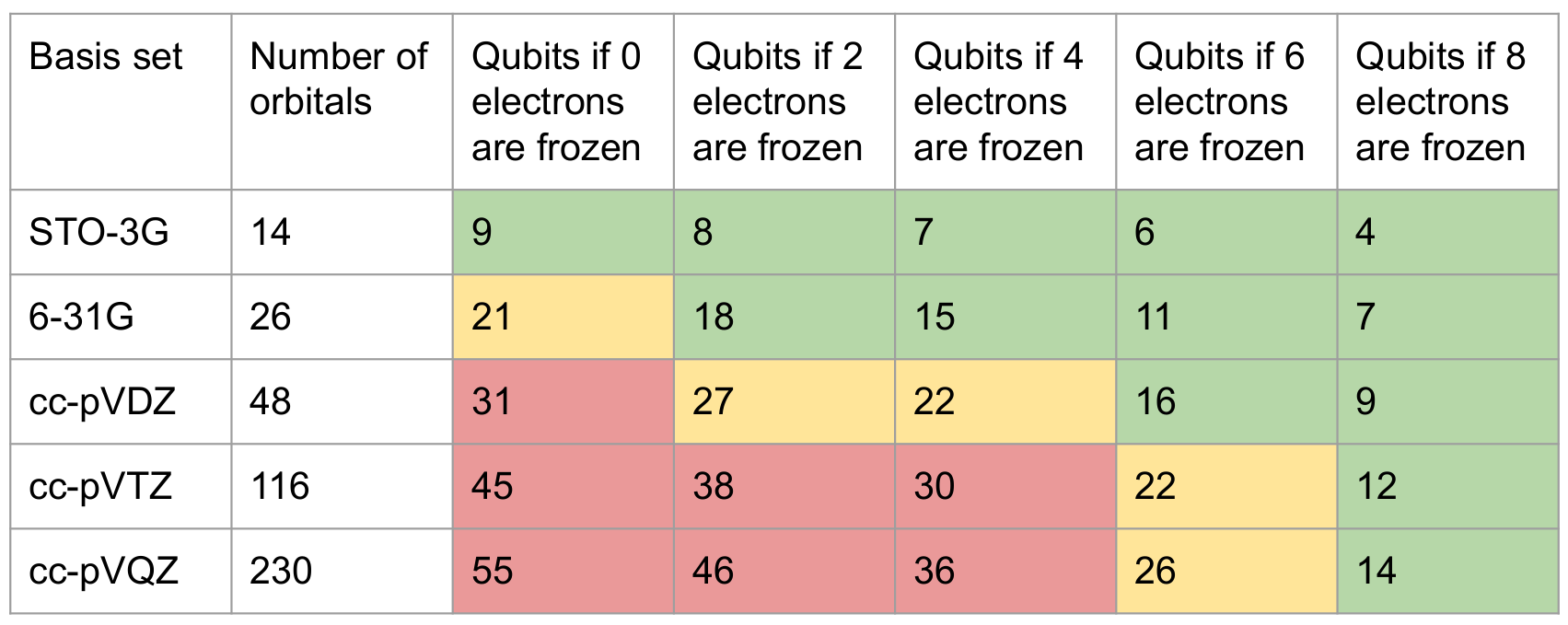
The following table shows the qubit requirements for water with respect to different basis sets and frozen orbitals:
Efficient quantum computing with parameterized tensor networks as matrix product states (MPS) and operators (MPO)
Tensor networks have shown that they can be applied to encode quantum chemistry problems in a highly efficient way to apply calculation routines for various molecular properties.
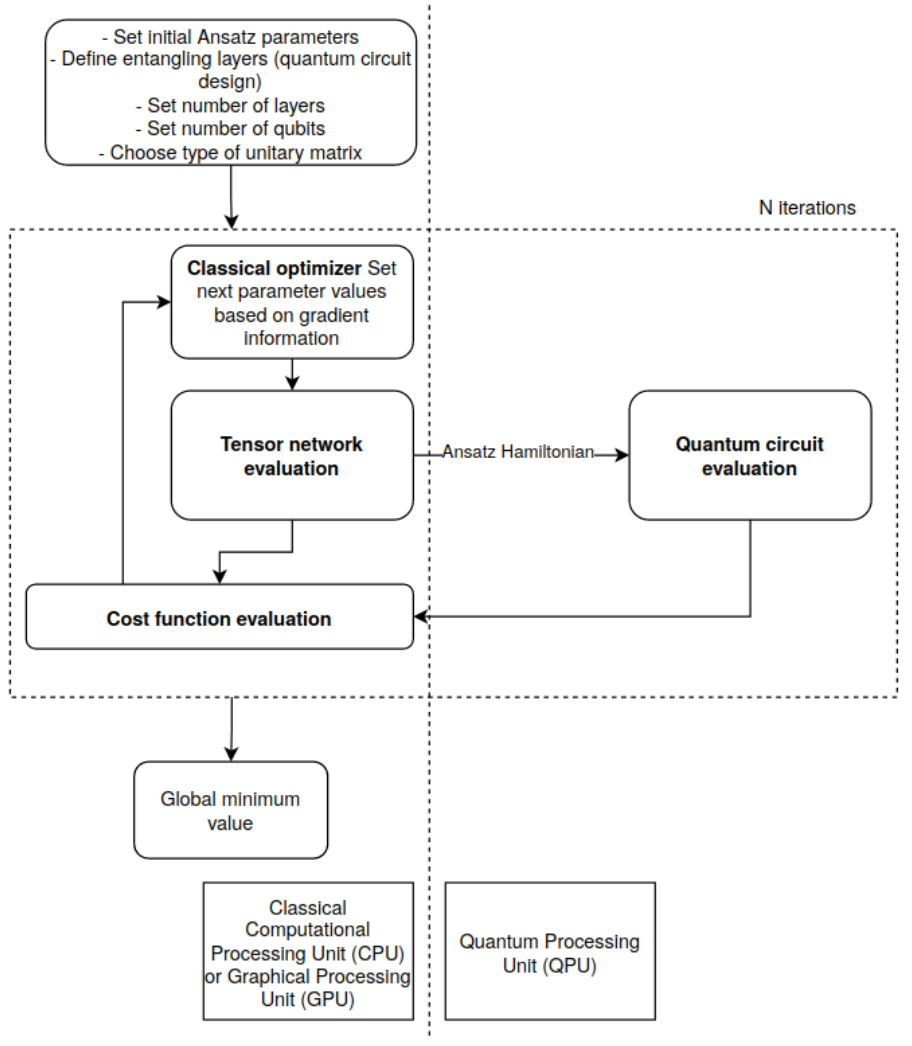
The TN-VQE method depicted in our paper 2 was the starting point for us to develop a tensor network based approach to leverage classical computing to perform as much computational effort for a quantum chemistry calculation as possible to only make the most crucial calculation run on a QPU.
The Tensor Network-Assisted Variational Quantum Eigensolver (TN-VQE) is a hybrid quantum-classical algorithm that combines the strengths of tensor network methods with the Variational Quantum Eigensolver (VQE) to improve convergence and accuracy when finding ground state energies of quantum systems. The tensor network construction can be separated from the specific quantum algorithm (VQE) and one can combine the generated Hamiltonian in different ways with other algorithms.
Purpose
Traditional VQE algorithms face several challenges on current NISQ (Noisy Intermediate-Scale Quantum) devices:
- Barren plateaus: Optimization landscapes where gradients vanish, causing the algorithm to stall
- Initialization sensitivity: Poor choice of initial parameters can prevent convergence
- Shallow circuit limitations: NISQ devices require shallow circuits, limiting expressiveness
TN-VQE addresses these challenges by incorporating parameterized tensor networks to better represent the quantum many-body system before the quantum circuit optimization.
Benefits
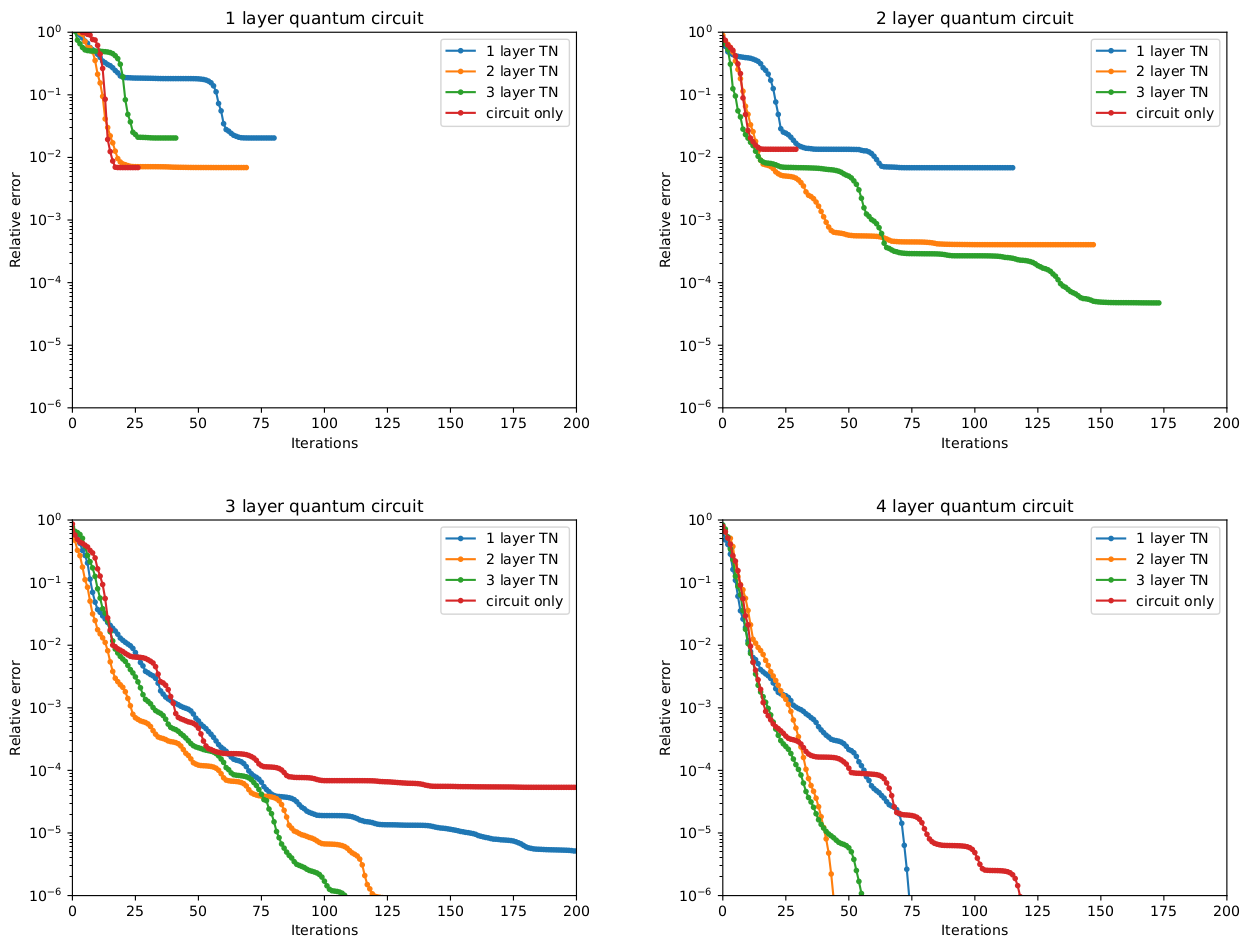
- Improved convergence: TN-VQE demonstrates better convergence compared to randomly-initialized quantum circuits, particularly for circuits with fewer layers where standard VQE often fails to converge.
- Reduced circuit depth: The tensor network assists the quantum circuit by better encapsulating the complexity of quantum many-body systems, allowing accurate results with shallower circuit depths suitable for NISQ devices.
- Better gradient properties: The TN-VQE approach exhibits smaller gradient magnitudes during optimization, suggesting: More efficient parameter updates, a smoother optimization landscape and reduced sensitivity to noise in quantum simulations.
How It Works
The TN-VQE splits the optimization task between a classical tensor network and a quantum circuit. The minimization problem becomes:
where:
- \(U(\theta)\): Parameterized unitary tensor network (classical)
- \(U(\phi)\): Parameterized quantum circuit (quantum)
- \(H\): Problem Hamiltonian
-
\(\theta, \phi\): Parameters optimized simultaneously
-
Hamiltonian representation: The system Hamiltonian is encoded as a Matrix Product Operator (MPO).
- Unitary tensor network: A parameterized classical tensor network \(U(\theta)\) wraps around the Hamiltonian, improving its representation. Quantum circuit: A standard parameterized quantum circuit \(U(\phi)\) prepares quantum states.
- Joint optimization: Both \(\theta\) and \(\phi\) are optimized simultaneously using gradient descent.
TaskType: tn_qc_opt
- Inputs:
h_coeff_values: 1-d array (floats), list The coefficients of the Hamiltonian
h_operators: List The operators defining the Hamiltonian, the order should correspond to H_coeff_values. Can be in three forms:
fermionic operators: List (tuples)Each Hamiltonian term (consisting of a string of fermionic creation and/or annihilation operators) is represented by a tuple of 2-tuples (each 2-tuple representing an operator). The first element of the 2-tuple is an integer, representing the site the operator acts on. The second element is a boolean: True (or 1) represents a creation operator, False (or 0) represent an annihilation operator See OpenFermion (https://quantumai.google/openfermion/tutorials/intro_to_openfermion) Example: \(a_4^\dagger a_2 a_1\) = ((4,1),(2,0),(1,0)) or ((4,True),(2,False),(1,False))qubit operators: List (tuples)Each Hamiltonian term (consisting of a string of single qubit pauli operators) is represented by a tuple of 2-tuples (each 2-tuple representing an operator). The first element of the 2-tuple is an integer, representing the site/qubit the operator acts on. The second term is a string denoting the type of operator ('X', 'Y' or 'Z'). See OpenFermion Example: \(\sigma_0^x \sigma_1^y \sigma_3^z\) = ((0,'X'),(1,'Y'),(3,'Z'))qubit operators: List (strings)Each string represents a term, where each operator is denoted by the corresponding letter ('X', 'Y' or 'Z') followed by an integer represeting the site/qubit it acts on. The operators should be seperated by a space. Example: \(\sigma_0^x \sigma_1^y \sigma_3^z\) = "X0 Y1 Z3"-
Pauli strings: List (strings)Each string represents a qubit operator term in the format of a Pauli string. Each string defines the pauli operator for each qubit ('I', 'X', 'Y' or 'Z'), and are of the length of the total number of qubits. Example: \(\sigma_0^x \sigma_1^y \sigma_3^z\) = 'XYIZ' -
Optional Inputs:
n_layers_network: int Number of layers for the classical tensor network, parametarized by theta. (Default: 1)
qasm_ansatz: string OpenQASM 3.0 circuit ansatz as a parameterized quantum circuit, with its free parameters declared as input arrays. It is parsed with qiskit.qasm3.loads on every backend, so the same string is accepted whether the backend is a Qiskit or a Pennylane one, and the number of qubits it declares must match the number of qubits of the Hamiltonian.
(Default for Qiskit backends: n_local circuit with Rz Ry Rz rotations and Cx entanglement with 'sca' connectivity.
Default for Pennylane backends: strongly entangled layers circuit)
The circuit is read with Qiskit's qubit ordering on every backend: q[i] of the QASM circuit is the qubit that index \(i\) of the Hamiltonian operators refers to. The same convention holds whether the backend is a Qiskit or a Pennylane one, and for both measurement methods, so the same QASM string gives the same energy everywhere.
n_layers_circuit: int If using the default ansatz circuits: Number of layers for the quantum circuit (parametarized by phi).
(Default: 3 of qasm_ansatz is None, 1 otherwise)
tn_ansatz: str Which family of two-qubit gates the M tensors of the tensor network \(U(\theta)\) are drawn from. This sets both what \(U(\theta)\) can represent and how many parameters per node theta holds. (Default: 'rotation_3param')
'rotation_1param'A real rotation applied to each of the two wires, 1 parameter per node. Because the gate factorises across the wires, a network of these cannot entangle: it only changes the local basis of each qubit.'rotation_3param'The most general single-qubit rotation applied to each of the two wires, 3 parameters per node. Also non-entangling.'givens'A Givens rotation mixing the two wires, 1 parameter per node. Under the Jordan-Wigner encoding of adjacent spin-orbitals this is a single-particle (orbital) basis rotation: it entangles, it conserves particle number, and \(U^\dagger H U\) stays a two-body fermionic Hamiltonian, so its Pauli-string count saturates instead of growing with the number of layers.'number_preserving'The most general number-preserving two-qubit gate (an arbitrary U(2) on the singly-occupied subspace plus a free phase on each of the empty and doubly-occupied states), 5 parameters per node. A strict superset of'givens', but not a single-particle transformation, so \(U^\dagger H U\) picks up higher-body terms and many more Pauli strings. Use it when the Givens family is too rigid and the extra measurement cost is affordable.
three_para_tn: bool Deprecated, superseded by tn_ansatz. Task inputs written before the families were named are still accepted: True selects 'rotation_3param' and False selects 'rotation_1param'. Only checked if tn_ansatz is not given.
theta_init: array Initial guess for theta parameters (defining the tensor network). Its shape depends on tn_ansatz through the number of parameters per node listed above, and on n_layers_network. When a mapping_matrix is given together with tn_ansatz: 'givens', theta parametrizes an orbital rotation on the spatial orbitals instead of a network over the qubits, so it is the smaller shape that rotation needs. (Default: zeros)
phi_init: array Initial guess for phi parameters (defining the quantum circuit ). (Default: random)
conv_tol: float Convergence tolerance, handed to scipy.optimize.minimize as tol. (Default: 1e-6)
opt_method: str Optimization solver method. Available inputs are the same as accepted as method by scipy.optimize.minimize. (Default: "COBYLA")
n_iterations: int Number of maximum iterations for optimization. Note that some optimization solvers perform several function calls per iteration. (Default: None, which leaves the iteration budget to the solver's own default)
COBYLA is the exception: it reads the budget as a count of function evaluations and needs one more than the number of parameters it varies to build its initial simplex. A budget below that is rejected with an error naming the minimum, rather than being silently raised by scipy, so a run always uses the budget the input asked for. Only the parameters the chosen optimization_mode varies are counted.
opt_options: dict Further options handed straight to the options argument of scipy.optimize.minimize, so the accepted keys are the ones the chosen opt_method documents (e.g. rhobeg for COBYLA, gtol for BFGS). Entries here override the defaults the task sets, including the maxiter that n_iterations fills in.
n_shots: int Number of measurement shots per circuit or per expectation value. The default is None, which leaves the shot count to the backend: Pennylane simulators then evaluate expectation values analytically (exactly), and Qiskit backends fall back on the estimator's own default.
backend: str: Definition of which device or simulator/emulator should run the quantum circuit. Supported backends through both Qiskit and Pennylane. Currently accepted inputs (Default: "default.qubit", a Pennylane simulator):
- Qiskit simulators: 'qasm_simulator', 'statevector_simulator', 'unitary_simulator', 'aer_simulator'
- Qiskit IBM hardware: (ibm_NAME, e.g. ibm_berlin) or fake IBM backends (fake_NAME, e.g. fake_manila)
- Pennylane simulators: 'default.qubit', 'lightning.qubit', 'default.mixed', 'default.tensor'
measurement_method: str Can be 'pauli' or 'grouped'. Defines whether the evaluation of quantum expectation values of H are done by decomposing H into Pauli strings which are then measured ('pauli', the traditional way), or whether a MQS patented measurement scheme (described here) is used ('grouped'). (Default: 'pauli')
optimization_mode: str: Can be 'circuit', 'network' or 'both'. Decides which parameters are optimized: 'circuit' refers to regular VQE, where theta_init is taken to be the fixed values of the tensor network parameters while phi is varied; 'network' optimizes only the tensor network parameters theta, while phi_init is used to define the fixed quantum circuit (no quantum measurements are made in this mode); and 'both' optimizes both the quantum circuit parameters (phi) and the tensor network parameters (theta) simultaneously. (Default: 'both')
mapping_matrix: array 2-d, list (float) The mapping matrix \(D\) produced by the mapping method (mol_map), in the same sparse "row, column, value" format that task outputs it in. Supplying it tells the task that the Hamiltonian in h_coeff_values/h_operators is a mapped one, i.e. that its qubits index configurations rather than spin-orbitals. (Default: None, the Hamiltonian is read as an ordinary Jordan-Wigner one)
This is only relevant when tn_ansatz: 'givens' is coicen , and then makes \(U(\theta)\) a spin-restricted orbital rotation on the reduced register: \(D U D^\dagger\) is evaluated in closed form from the mapping matrix. measurement_method: 'grouped' is the natural partner here, since it works from the reduced operator itself and needs at most \(2^Q\) circuits however dense that operator is.
- Outputs:
VQE_energy: float The ground state energy of the input Hamiltonian, i.e. the lowest cost function value the optimization reached.
phi: list (floats) The values of the quantum circuit parameters phi reached during the optimization.
theta: list (floats) The values of the tensor network parameters theta reached during the optimization. On the orbital-rotation route (tn_ansatz: 'givens') these are the angles of the orbital rotation instead.
H_TN_opt_qubit: tuple (lists) The terms of Hamiltonian after tensor network optimization in Qubit operators. The first list includes the labels for the operators of the terms making up the Hamiltonian, in the following format: Each operator is represented by the corresponding letter ('X', 'Y' or 'Z') denoting its type, and an integer denoting which site/qubit it acts on. When a term involves more than a single operator, they are separated by a space. The second list holds the respective coefficient for each term.
If the original Hamiltonian was derived using the Jordan-Wigner transform, the output Hamiltonian can be turned back into a Fermionic Hamiltonian using OpenFermion. Should you want to do that transform, here is an example for how that can be derived from H_TN_opt_qubit:
from openfermion.ops import QubitOperator
from openfermion.transforms import reverse_jordan_wigner

# Initialize Hamiltonian
QB_ham = QubitOperator()

for pair in zip(*H_TN_opt_qubit):
    QB_ham += QubitOperator(*pair)

# Transform qubit Hamiltonian to a Fermionic Hamiltonian
FO_ham = reverse_jordan_wigner(QB_ham)
FO_ham.compress()

print(FO_ham)

#Extract the coefficients and operators for each term
fermionic_operators = list(FO_ham.terms.keys())
H_TN_opt_fermionic = [FO_ham.terms[label] for label in fermionic_operators]
function_calls: int The number of times the cost function was called.
cost_history: list (floats) The history of the cost function during the optimization run, i.e. the value of the energy after each evaluation of the function.
param_history: list (arrays of floats) The history of the parameter values during the optimization run. Each entry holds only the parameters the chosen optimization_mode varies: phi and theta concatenated for 'both', phi alone for 'circuit' and theta alone for 'network'.
metadata: dict The metadata from the quantum computing runs/simulations. The format will depend on which device/backend is used. If a qiskit backend was used, this will be a list of dictionaries with the metadata from each estimator run. If a pennylane QNode was used, this will be a dictionary of the output of tracker.history. For both pennylane and qiskit metadata, and when optimizing both \(\phi\) and \(\theta\), two keys are added: n_circuits and n_measured, that capture the number of expectation values needed for each cost function evaluation and the number of measured expectation values respectively. The latter can be lower than the former due to measurement caching when only \(\theta\) is updated. This output is absent when optimization_mode is 'network', since that mode makes no quantum measurements.
OptimizeResult: dict The full output of scipy.optimize.minimize as a dictionary. It covers only the parameters the chosen optimization_mode varied.
Correlation optimized virtual orbitals (COVO)
The COVO method addresses a fundamental challenge in quantum computing simulations of molecular systems: reducing the dimensionality of the problem while capturing significant electron correlation. Traditional approaches using Hartree-Fock virtual orbitals often fail to capture meaningful correlation energy, particularly when using plane-wave basis sets where virtual orbitals tend to be scattering states with weak interactions.
COVO generates optimized virtual orbital spaces specifically designed to capture electron-electron correlation efficiently, enabling accurate quantum chemistry calculations with far fewer orbitals than conventional methods.
Key Features
- Efficient Correlation Capture: Captures significant correlation energy with a minimal number of virtual orbitals (typically 4-18 orbitals)
- Plane-Wave Compatibility: Specifically designed to work with pseudopotential plane-wave Hamiltonians, extending quantum chemistry methods beyond traditional atomic basis sets
- Systematic Convergence: Demonstrates steady convergence toward benchmark results as more virtual orbitals are added
- Quantum Computing Ready: Dramatically reduces qubit requirements for near-term quantum devices while maintaining accuracy
- Pairwise Optimization: Generates virtual orbitals by optimizing small configuration interaction (CI) Hamiltonians containing pairwise electron correlations
- Periodic System Extension: Can be extended to periodic systems using Filon integration strategies for exact exchange and Brillouin zone integration
Benefits
Reduced Computational Cost: With just 4 COVOs, the method can recover a significant portion of correlation energy comparable to much larger basis set calculations (e.g., matching cc-pVTZ results with only 4 virtual orbitals for H2).
Near-Term Quantum Device Compatibility: By reducing the number of required qubits while maintaining accuracy, COVO makes quantum simulations feasible on current noisy intermediate-scale quantum (NISQ) devices.
Versatile Applications: The optimized orbital spaces can be used with various many-body methods including: - Full Configuration Interaction (FCI) - Coupled Cluster (CC) theory - Møller-Plesset perturbation theory - Variational Quantum Eigensolver (VQE) - ADAPT-VQE
Extensivity: Maintains proper size-extensivity for dissociated systems, with errors decreasing systematically as more COVOs are included.
How It Works
The COVO algorithm generates virtual orbitals sequentially by optimizing small select CI Hamiltonians:
-
Initialization: Start with filled Hartree-Fock orbitals from a reference calculation
-
Pairwise CI Construction: For each virtual orbital to be optimized (φᵥ), construct a small CI Hamiltonian containing:
- The ground state filled orbitals
- The current virtual orbital being optimized
-
Configuration state functions representing electron pairs
-
CI Diagonalization: Diagonalize the CI matrix to obtain expansion coefficients and the lowest eigenvalue
-
Gradient Optimization: Calculate the gradient of the energy with respect to the virtual orbital and update using conjugate-gradient or similar optimization methods
-
Orthogonality Constraint: Ensure the new virtual orbital remains normalized and orthogonal to all previously computed filled and virtual orbitals
-
Iteration: Repeat for the next virtual orbital until the desired number of COVOs is generated
TaskType: covo
- Inputs:
geometry: 1-d array, list Cartesian coordinates (x,y,z), in angstroms, representing the 3D position of all atoms (e.g., [0.0000, 0.0000, 0.0000, 0.0000, 0.0000, 0.6000])
symbols: 1-d array, list Atomic elements (e.g., ["H","H"]) that directly correspond to the coordinates in the geometry array.
cell_size: value (float) The dimension of the simulation box, in Ångstroms [Å].
periodic: True/False Boolean flag indicating whether the system is an infinite repeating lattice (True) or an isolated molecule (False)
cutoff: value (float) Energy cutoff threshold used to truncate the basis set.
n_virtual_orbitals: value (integer) The number of unoccupied (virtual) molecular orbitals to include for advanced correlation or active space calculations.These are the COVO orbitals to be optimized.
charge: value (integer) The net electric charge of the system (e.g., 0 for neutral, -1 for an anion).
multiplicity: value (integer) The spin multiplicity of the system, defined as M = 2S + 1 (e.g., M=1 for a singlet state with all electrons paired with S=0).
tolerance: value (float) The numerical convergence threshold for the Self-Consistent Field (SCF) iterations.
- Outputs:
one_electron_integrals: array 2-d (float) A matrix (N x N) containing the kinetic energy and nuclear attraction terms for individual electrons within the basis set.
two_electron_integrals: array 4-d (float) A tensor (N x N x N x N)representing the electron-electron repulsion interactions.
hf_energy: value (float) The molecular ground-state energy [Hartree] calculated using the mean-field Hartree-Fock approximation.
fci_energy: value (float) The exact ground-state energy (Hartree) within the chosen COVO optimized virtual orbitals, calculated via Full Configuration Interaction.
vqe_energy value (float) The optimized energy (Hartree) computed using the Variational Quantum Eigensolver (VQE) algorithm with the chosen COVO optimized virtual orbitals.
hamiltonian: array 2-d (float) The matrix representation of the system's electronic Hamiltonian, mapping the total energy operators.
Zero-noise Extrapolation for Variational Quantum Algorithms
Variational Quantum Algorithms (VQAs) like the Variational Quantum Eigensolver (VQE) are specifically designed to run effectively on near-term quantum computers, which lack quantum error correction. Consequently, there’s substantial interest in determining whether these algorithms can provide practical computational advantages. In chemistry, accurately predicting molecular energies with classical methods (such as Density Functional Theory, Coupled Cluster, and Full Configuration Interaction) can be extremely computationally expensive. Quantum computing, with its natural ability to represent quantum entanglement and correlations between particles, has the potential to significantly accelerate these calculations. Thus, enhancing VQAs through error mitigation methods such as Zero-noise Extrapolation (ZNE) is relevant to areas such as pharmaceuticals, energy, and catalysis – which together have a global market size of trillions of dollars – for molecular and material design both in industry and academic research.
ZNE works by intentionally increasing noise in quantum circuits via redundant gates, measuring the expectation value of a circuit with respect to some operator at different noise levels, and then extrapolating with a curve fit to estimate the zero-noise result.
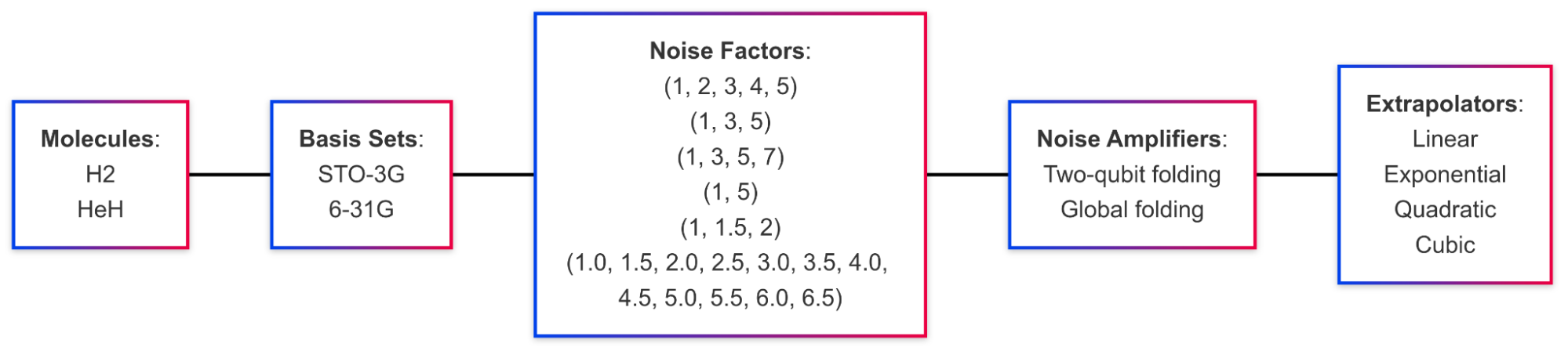
MQS has systematically benchmarked different ZNE configurations – combinations of noise factors, noise amplification methods, and extrapolation techniques – to identify which configurations yield the most accurate and reliable improvements to VQE, as well as which configurations lead to unrealistic energy estimates.
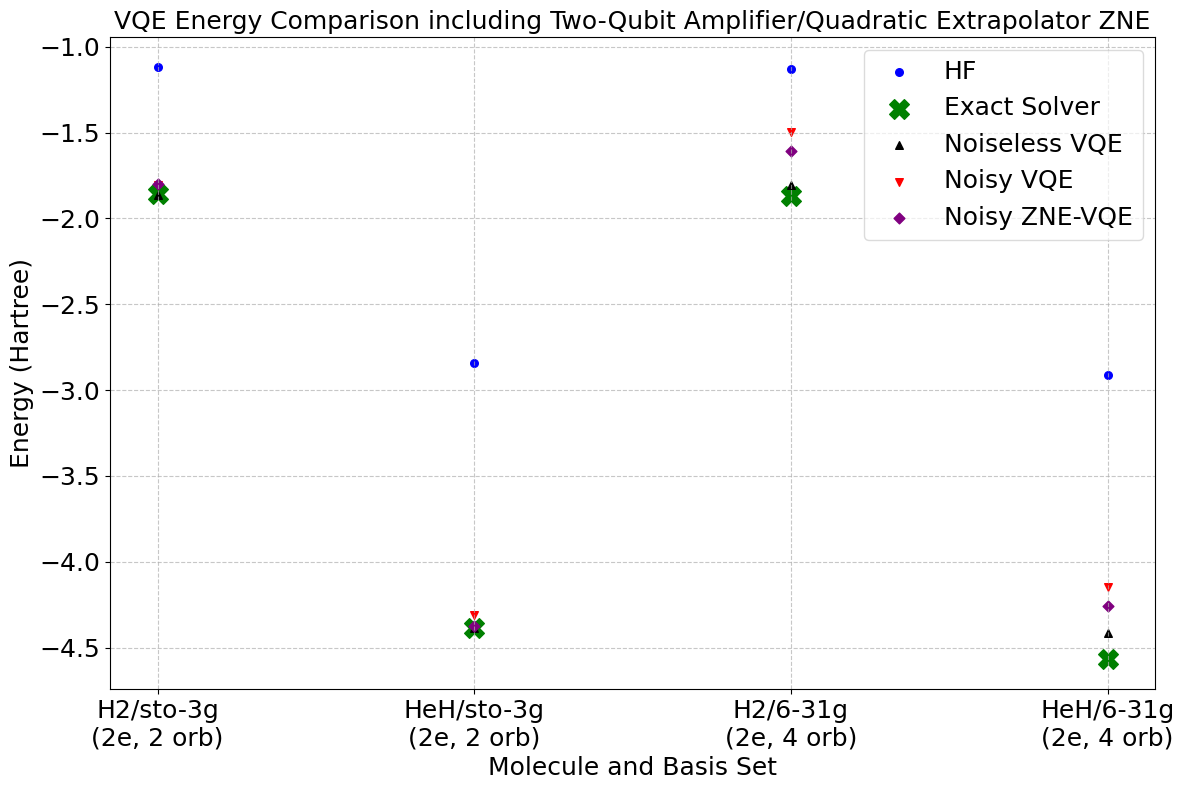
We ran a series of experiments to benchmark various ZNE configurations for VQE using Qiskit and classical simulation with the IBM Brisbane noise model. From the experiments run, the best-performing ZNE configurations for the analyzed VQE cases in terms of stability and accuracy involve a large number of noise scalars (such as 12 factors between 1 and 6.5), two-qubit gate folding, and quadratic extrapolation. The cubic and exponential extrapolation methods can be prone to producing unphysical energies. By mapping which options consistently converge toward the noiseless energy and which diverge, a recipe for reliable error mitigation in VQE is provided.
ZNE can help one progress towards chemical accuracy with VQAs as shown in our results from the best-performing configuration. Note that this experiment was not tuned for chemical accuracy, it simply demonstrates how ZNE can take one closer to that target.
Genetic gate-based quantum circuit generation
See Xenakis repository: Link
Benchmarking framework
Quantum computing research articles from MQS
- Resource efficient method for representation and measurement of constrained electronic structure states with a quantum computer
- A joint optimization approach of parameterized quantum circuits with a tensor network
- Comparative Studies of Quantum Annealing, Digital Annealing, and Classical Solvers for Reaction Network Pathway Analysis and mRNA Codon Selection
- Quantum phase estimation with optimal confidence interval using three control qubits
Completed and current MQS projects:
PhotoQ: Photonic quantum computing project involving measurement-based quantum computing and Gaussian boson sampling (GBS).
DLR Quantum Computing Initiative - QuantiCoM Project: Advanced water simulations with classical and quantum computing.
Q-Chemion: end to end quantum computing calculation pipeline with QEDMA, Oxford Ionics, Copenhagen University and the Technical University of Denmark (DTU).
MQS x Fraunhofer SCAI Benchmarking Framework: In collaboration with Fraunhofer MQS has developed a quantum computing algorithms benchmarking framework to assess methods related to quantum computing enhanced quantum chemistry calculations (to be released).
Quantum Innovation Challenge: Quantum Innovation Challenge in collaboration with Novo Foundation, BioInnovation Institute (BII), DCAI, QAI Ventures and many more. The annual challenge focuses on applications of quantum computing within the life sciences.
-
Kaur Kristjuhan and Mark Nicholas Jones. Resource efficient method for representation and measurement of constrained electronic structure states with a quantum computer. 2023. URL: https://arxiv.org/abs/2303.01122, arXiv:2303.01122. ↩
-
Clara Ferreira Cores, Kaur Kristjuhan, and Mark Nicholas Jones. A joint optimization approach of parameterized quantum circuits with a tensor network. 2024. URL: https://arxiv.org/abs/2402.12105, arXiv:2402.12105. ↩↩